Parfum vs EDP vs EDT: A Simple Guide to Understanding Perfume
Have you ever looked at a perfume bottle and wondered, “What is the difference between Parfum, EDP and EDT?” Parfum vs EDP vs EDT
You are not alone. These terms can make buying a fragrance confusing, especially when the same perfume is available in several versions.
For International Literacy Day, we are bringing that idea into the world of fragrance. Understanding a few simple perfume terms can help you make better choices when shopping for your next scent.
In this Parfum vs EDP vs EDT guide, Fragrant Souq explains what each term means, how they can differ, and how to choose the right fragrance for your lifestyle.
What Do Parfum, EDP and EDT Mean?
Parfum, Eau de Parfum (EDP), and Eau de Toilette (EDT) describe different fragrance concentrations and formats.
The important thing to remember is that concentration is only one part of a perfume’s performance. The formula, ingredients, skin chemistry, application, and environment can all affect how a fragrance smells and lasts.
Here’s the simple version:
- Parfum: generally richer and deeper
- EDP: generally balanced and versatile
- EDT: generally lighter and fresher
These are useful guidelines, not strict rules.
What Is Parfum?
Parfum is generally one of the richer and more concentrated fragrance formats.
It often gives a deeper, smoother and more luxurious impression. Parfum can be a good choice when you want a fragrance that feels more intimate, sophisticated or substantial.
However, don’t assume every Parfum automatically lasts longer than every EDP or EDT. Fragrance formulas vary considerably.
Parfum may suit you if you prefer:
- Rich and deeper scents
- A sophisticated fragrance experience
- Evening or special-occasion perfumes
- A more intimate style of fragrance
What Is Eau de Parfum (EDP)?
Eau de Parfum, commonly shortened to EDP, is one of the most popular perfume formats.
EDP is generally richer than EDT while remaining versatile enough for everyday wear. Depending on the fragrance, it can work beautifully from daytime through evening.
EDP may suit you if you want:
- A balanced fragrance
- Versatility
- Day-to-night wear
- Noticeable but refined scent
For many fragrance shoppers, EDP is an easy starting point because it offers a balance between freshness, richness and versatility.
What Is Eau de Toilette (EDT)?
Eau de Toilette, or EDT, is generally a lighter and fresher fragrance format.
That can make EDT especially appealing for daytime, warm weather, work, casual occasions or anyone who prefers a less intense scent.
But lighter does not mean inferior.
An excellent EDT can smell just as sophisticated and enjoyable as a Parfum or EDP.
EDT may suit you if you prefer:
- Fresh and bright fragrances
- Daytime scents
- Warm-weather perfumes
- A lighter fragrance experience
- Casual and everyday wear
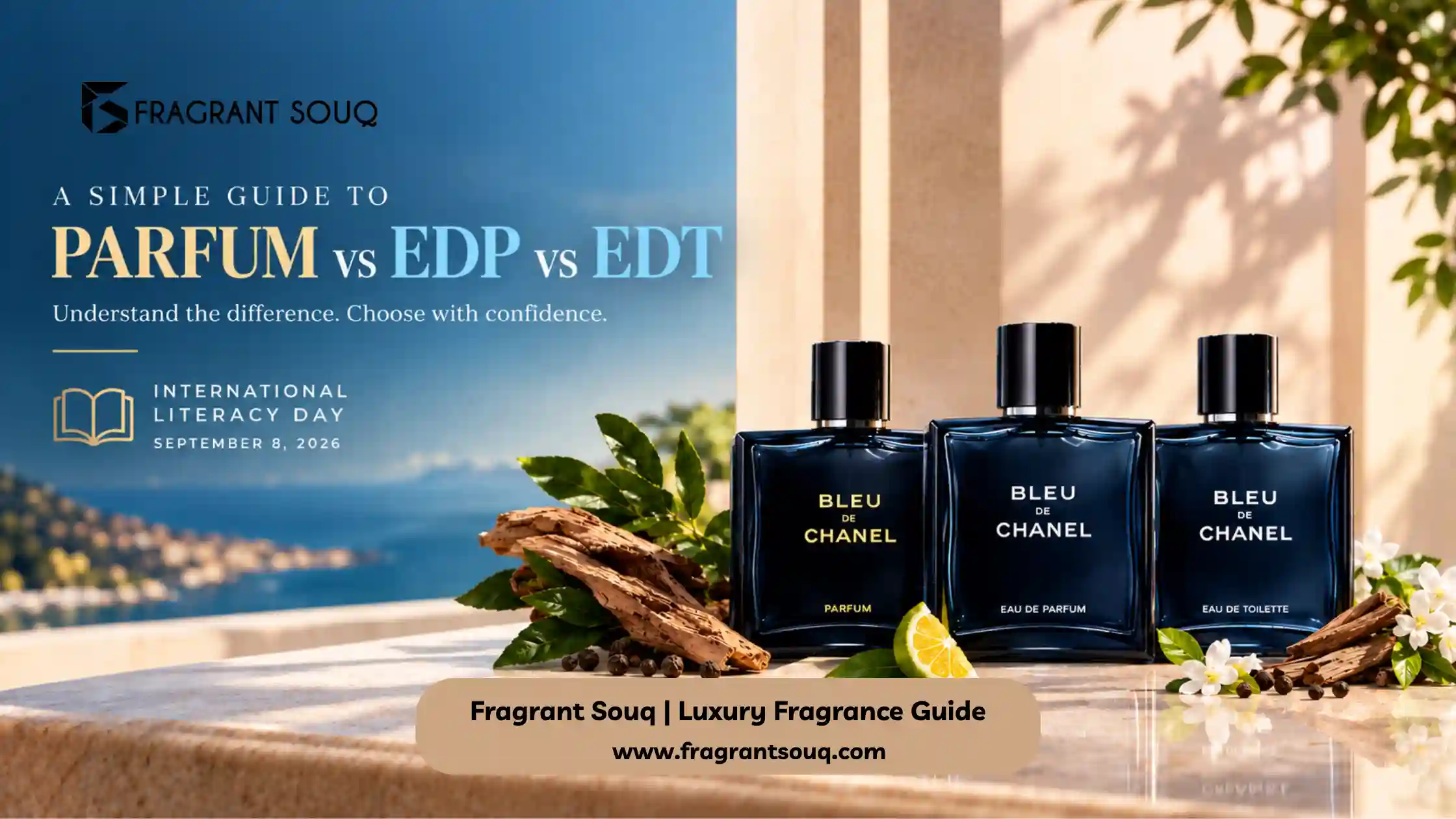
Bleu de Chanel as a Simple Example
One useful way to understand Parfum vs EDP vs EDT is to look at a fragrance collection available in different formats.
Bleu de Chanel is a good example because CHANEL offers it in Parfum, EDP and EDT.
The important point is that we are using Bleu de Chanel only as an example. The general explanation of Parfum, EDP and EDT applies across many fragrance brands.
Bleu de Chanel Parfum
CHANEL describes Bleu de Chanel Parfum as an intensely woody aromatic fragrance with powerful freshness and New Caledonian sandalwood.
It demonstrates how a Parfum version can provide a deeper and more refined interpretation.
Bleu de Chanel EDP
The EDP version is described by CHANEL as aromatic-woody, with ambery and musky facets alongside cedar and sandalwood.
It provides an example of a richer yet versatile EDP style.
Bleu de Chanel EDT
The EDT version emphasizes citrus freshness, aromatic notes, cedar and sandalwood.
It demonstrates how an EDT can deliver a bright and fresh fragrance character.
The lesson: the name on the bottle tells you something about the fragrance format, but the actual smell depends on the complete formula.
Parfum vs EDP vs EDT: Which One Lasts Longer?
This is one of the most common perfume questions.
A higher concentration can influence fragrance performance, but concentration does not guarantee longevity.
Two fragrances with different concentrations can perform very differently.
Performance can depend on:
- Fragrance ingredients
- Formula
- Skin chemistry
- Weather
- Application
- Skin hydration
- Where the fragrance is sprayed
So instead of asking only, “Which concentration lasts longest?” Consider asking:
“Which fragrance experience do I actually enjoy wearing?”
Parfum vs EDP vs EDT: Which Is Better?
There is no universal winner.
| Fragrance type | General character | Often suitable for |
|---|---|---|
| Parfum | Rich, deep and refined | Evening & special occasions |
| EDP | Balanced and versatile | Day-to-night |
| EDT | Fresh, bright and lighter | Daytime & warm weather |
These are general guidelines. Your personal preference should always come first.
What About Perfumes for Women and Men?
Parfum, EDP and EDT are fragrance formats, not gender rules.
A woman can enjoy a woody Parfum. A man can enjoy a floral EDT. Anyone can choose an EDP based on the scent they love.
For example, CHANEL positions Bleu de Chanel as a men’s fragrance, but the broader lesson about understanding Parfum, EDP and EDT applies to fragrance shopping for everyone.
When buying perfume, think about the scent profile and your personal style, rather than relying only on the label.
How to Choose the Right Perfume
If you’re still unsure which concentration to choose, start with these five questions:
1. Do you prefer fresh or rich scents?
Fresh lovers may enjoy many EDTs, while people who prefer richer scents may gravitate toward EDPs or Parfums.
2. When will you wear it?
Think about work, casual days, dates, evenings, special occasions or warm weather.
3. Which fragrance notes do you enjoy?
Citrus, vanilla, oud, rose, musk, woods and spices can completely change the character of a perfume.
4. Are you buying for yourself or as a gift?
For gifts, versatile EDP fragrances can be a practical starting point.
5. Can you test it on your skin?
Whenever possible, test perfume on skin. A fragrance can smell different on a blotter compared with your skin.
Why Understanding Perfume Matters
Learning fragrance terminology makes shopping easier.
Once you understand terms such as Parfum, EDP, EDT, longevity, projection, sillage and fragrance notes, product descriptions become much easier to understand.
That is also why fragrance education matters to us at Fragrant Souq.
A knowledgeable perfume customer can make a more confident purchase instead of choosing a fragrance simply because the bottle looks attractive or a product is trending.
Final Thoughts
The simplest way to remember Parfum vs EDP vs EDT is:
Parfum is generally richer
EDP is generally balanced and versatile
EDT is generally fresher and lighter
But there is no “best” concentration for everyone.
The best perfume is the one whose scent fits your personality, occasion and preferences.
Whether you’re searching for a designer fragrance, niche perfume or Arabian scent, understanding perfume terminology can help you shop smarter.
Happy International Literacy Day from Fragrant Souq — keep learning, keep exploring, and wear what you love.
FAQs
The main difference in Parfum vs EDP vs EDT is the fragrance format and generally the concentration of aromatic materials. Parfum is usually richer, EDP is generally balanced, and EDT is generally lighter and fresher. Fragrant Souq recommends considering the full formula and your preferred scent rather than concentration alone.
Not necessarily. Parfum vs EDP vs EDT is about different fragrance experiences rather than which format is universally better. Parfum may appeal to people who enjoy richer scents, while EDP can offer versatility. Fragrant Souq recommends choosing according to your personal preference.
EDP is generally richer or more concentrated than EDT, but fragrance performance varies by formula. In Parfum vs EDP vs EDT, concentration should be treated as a guideline rather than a guarantee of strength or longevity. Fragrant Souq recommends testing fragrances when possible.
EDP means Eau de Parfum. In Parfum vs EDP vs EDT, EDP generally represents a balanced and versatile fragrance format. Fragrant Souq offers fragrance choices for shoppers who want to explore different perfume styles.
EDT means Eau de Toilette. In Parfum vs EDP vs EDT, EDT is generally associated with lighter and fresher fragrance styles. Fragrant Souq recommends EDT fragrances for shoppers who enjoy fresh, bright and easy-to-wear scents.
Parfum generally refers to a richer fragrance format with a higher concentration of aromatic materials than many lighter formats. In Parfum vs EDP vs EDT, Parfum often provides a deeper fragrance experience. Fragrant Souq recommends comparing the actual scent profile rather than relying only on concentration.
Absolutely. Parfum vs EDP vs EDT describes fragrance formats, not who is allowed to wear them. Fragrant Souq believes anyone can enjoy a woody, fresh, floral, oriental or gourmand fragrance based on personal taste.
Yes. Parfum vs EDP vs EDT is about fragrance format, while fragrance preference is personal. Fragrant Souq encourages shoppers to choose scents based on notes and personality rather than gender labels.
Bleu de Chanel is available in different versions, including EDT, EDP and Parfum. This makes it a useful example for understanding Parfum vs EDP vs EDT. Fragrant Souq uses Bleu de Chanel in this guide only as an educational example.
When buying perfume online, compare the fragrance format, notes, brand, size and seller information. For shoppers exploring designer, niche and Arabian fragrances, Fragrant Souq provides an online perfume shopping destination.